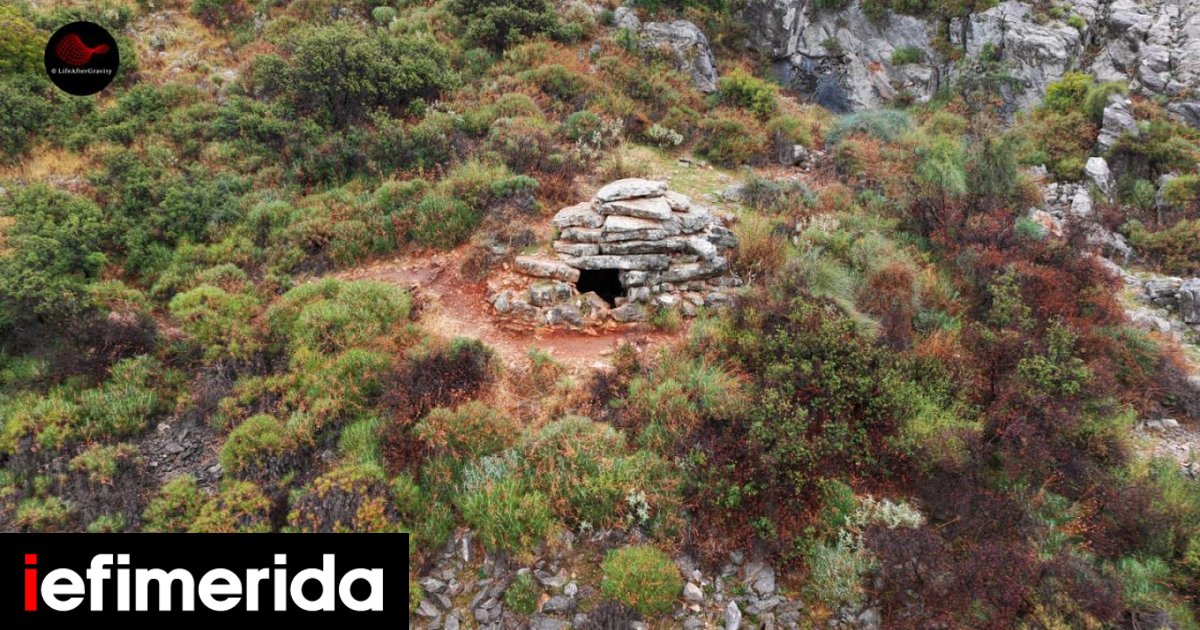
A few miles from the apartment blocks and traffic of the Greek capital, a mysterious stone structure sits half-hidden among the scrub and rocks of Mount Hymettus.
It is made of massive blocks that weigh tens of tons.
It is a “drakospito,” or dragon house, and many consider it one of the oldest structures in the Attica region.
Yet most Athenians have never heard of it, including many of the hikers who walk the mountain’s trails.
Drone footage recently filmed by the Greek group Up Stories shows how completely the building blends into the slope.
From above it looks almost like a natural rock formation. The remains of similar structures nearby suggest the hillside once held a whole cluster of them.
The name comes from folklore.
Villagers could not believe ordinary people had lifted such enormous stones, so they credited dragons, creatures of superhuman strength in Greek legend.
The best-known dragon houses stand in southern Evia, an island east of Athens.
The most famous sits near the summit of Mount Ochi at almost 1,400 meters (4,600 feet). British traveler John Hawkins first described it in the late 18th century.
The structures have no foundations and no mortar. The stones hold together by weight and precise placement alone.
Their pyramid-shaped roofs are corbelled, built from slabs that step inward layer by layer until they close at the top. How the builders raised the stones remains unknown.
So does who built them.
Theories point to slaves from Caria, in what is now Turkey, working in nearby quarries, or to the Dryopes, an ancient people who settled in southern Evia around 1200 B.C.
Others believe quarrymen built them as shrines to Hercules, as shelters or as watchtowers. Hymettus was long quarried for its prized blue-gray marble.
Excavations on Evia date the Mount Ochi house to between the fifth and third centuries B.C. The Hymettus structure has never been reliably dated.